
The Complete Guide to PET Bottle Production: From Preform to Finished Product
Introduction
PET bottle production is one of the most efficient, scalable, and widely used packaging processes in the world. From drinking water and
carbonated beverages to cosmetics, pharmaceuticals, and edible oils, PET bottles have become a global standard. But behind every clear,
lightweight bottle is a precise manufacturing process that requires the right equipment, high-quality materials, and optimized settings.
As an engineer at Link-Tech Machinery, I’ve supported factories across Southeast Asia, the Middle East, and Africa in setting up complete
PET bottle production lines. In this article, I’ll walk you through the entire process — from preform selection to final bottle inspection — to
help you understand how PET bottles are made and how our machines ensure consistent, high-quality results.

1. Step One: Preform Manufacturing or Procurement
PET bottles begin as preforms, which resemble small test tubes. You can either:
Produce your own preforms using injection molding machines, or
Purchase preforms from suppliers
Key considerations when selecting preforms:
Material Grade: Food-grade PET is required for beverages and consumables.
IV Value: Determines melt strength and clarity.
Neck Finish: Must match caps, pumps, or closures.
Weight: Impacts final bottle strength and cost.
Dimensional Accuracy: Essential for consistent blowing.
At Link-Tech, we provide both standard preforms and custom preforms designed for specific bottle shapes.
2. Step Two: Preform Loading and Heating
Before stretching and blowing, preforms are heated to the ideal temperature (usually 90–120°C depending on design and material).
Heating Process:
Preforms enter an infrared heating oven
They rotate continuously for even heat distribution
Multi-zone heating allows precise temperature control
The neck area stays cool to maintain dimensional strength
Our machines use intelligent heating systems that auto-adjust lamp power for consistent quality.
3. Step Three: Stretch-Blow Molding
This is the core of PET bottle production. The heated preform is placed inside the mould and undergoes two actions simultaneously:
A. Stretching
A stretch rod extends downward to elongate the preform, improving molecular orientation and bottle strength.
B. Blowing
Compressed air inflates the stretched preform to fill the mould cavity, forming the final bottle shape.
Pressures involved:
Pre-blow pressure: Creates initial shape
Main-blow pressure: Expands the bottle fully
Exhaust stage: Releases air smoothly to avoid deformation
Link-Tech machines offer high-precision pressure control, essential for achieving clear, strong, and uniform bottles.
4. Step Four: Cooling
Cooling stabilizes the newly formed bottle’s structure.
Cooling methods include:
Mould cooling channels with chilled water
Internal air cooling in some bottle types
Ambient cooling after demolding
Good cooling ensures:
Better clarity
Shorter cycle time
Stronger bottle walls
Minimal shrinkage
Our moulds use optimized cooling channel designs for fast and even heat removal.
5. Step Five: Bottle Ejection and Trimming
Once cooled, the bottle is ejected from the mould and transferred to the conveyor.
Additional steps may include:
Neck trimming
Gate removal
Deflashing
Ink coding or date printing
For most PET bottles, only light trimming is required due to the precision of our moulds.
6. Step Six: Quality Inspection
Quality control is essential to ensure bottles meet industry standards.
Inspections include:
Wall thickness measurement
Neck dimension accuracy
Leak and pressure testing
Drop test
Top-load strength test
Visual inspection for haze, scratches, or deformation
Automated inspection systems can be added for high-speed production lines.
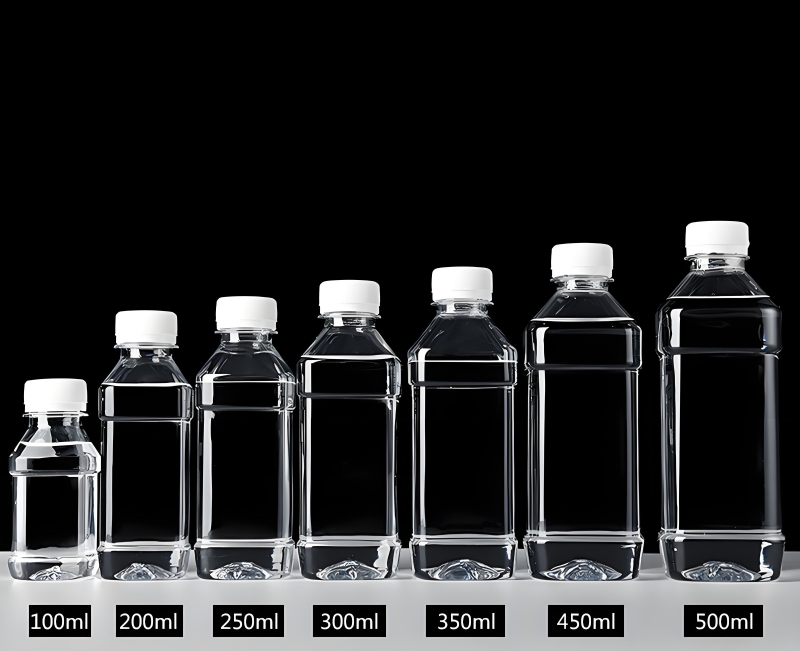
7. Step Seven: Packing and Storage
Finished bottles are packed for delivery or transferred directly to filling lines.
Typical packaging options:
Plastic bags
Cartons
Bale packing
Palletized stacks
For beverage factories, bottles often go straight to the filler within minutes of production.
PET Bottle Production Flow Summary
Preform Production / Purchase
Preform Loading
Heating (Multi-Zone IR Oven)
Stretch-Blow Molding
Cooling and Ejection
Quality Inspection
Packing and Storage
Each step must be optimized to maintain high quality and low production costs.
Link-Tech Machinery: Complete PET Bottle Production Solutions
We supply:
Fully automatic stretch blow molding machines
Semi-automatic PET blow molding machines
Custom moulds
Preforms and neck designs
Turnkey production lines
Training, installation, and lifetime support
Why customers choose Link-Tech:
High clarity, stable thickness, and strong bottle performance
Fast cycle time and low energy consumption
Easy operation for small, medium, and large factories
Proven reliability in harsh tropical environments
Full technical support worldwide
Whether you're producing water bottles, cosmetic containers, oil bottles, jars, or PC/Tritan items—our machines are engineered for long-term stability.
Conclusion
PET bottle production may seem simple from the outside, but it involves a precise sequence of heating, stretching, blowing, and cooling. With
the right preforms, moulds, and machine settings, manufacturers can achieve consistent, high-quality bottles at competitive production costs.
At Link-Tech Machinery, we help customers build reliable, efficient PET bottle production lines that meet today’s market demands.
If you’re planning a new project or upgrading your factory, reach out to us for professional guidance.


